Looking at homes in Lincoln, MA, you quickly notice that the town does not follow just one design script. Instead, Lincoln’s homes reflect a rare mix of historic farming roots, country-estate tradition, mid-century Modern design, and today’s conservation-minded building culture. If you are trying to understand what gives this market its character, this guide will help you read Lincoln listings more clearly and spot the architectural details that matter most. Let’s dive in.
Lincoln’s Landscape Shapes Its Homes
Lincoln’s architecture makes the most sense when you start with the land. The town manages 1,600 acres of municipal conservation land, and its trail network spans about 80 miles across 2,400 acres of conservation land and private property.
That conservation-first setting helps explain why so many homes in Lincoln feel set back from the road, surrounded by mature trees, and visually connected to their lots. Town and planning sources describe a landscape residents value for its open scenery, tree-lined country roads, older buildings in the center of town, and homes softened by irregular setbacks and generous foliage.
For you as a buyer or seller, that means house style in Lincoln is rarely just about the structure itself. Site placement, privacy, views, and how a home blends into the landscape all play a major role in how a property is experienced.
Historic Farmhouses and Estates
One of the clearest threads in Lincoln’s housing story is its agricultural past. Some of the town’s oldest homes began as part of working farms, and that history still shapes how many legacy properties look and feel today.
A strong example is the Codman Estate, which has remained in one continuous family line since about 1708. Historic New England describes it as a former 680-acre working farm, with an 18th-century inventory that included a mansion house, farm house, pottery shop, barn, granary, shay house, and stables.
That kind of property tells you something important about Lincoln’s historic homes. They were often part of a larger working landscape, not just standalone residences.
What Defines This Style
In Lincoln, farmhouse and country-estate properties often carry a more formal, land-based presence. You may see a main house with a clear front-facing core, along with barns, carriage houses, garden structures, or other outbuildings set apart from the primary residence.
The surviving Codman house itself reflects layers of change over time, including Georgian, Federal, Colonial Revival, and servants-wing elements. That evolution is part of the charm in Lincoln’s older homes, where architecture often tells a long, lived-in story rather than presenting one fixed style.
The Flint Farm and Codman Farm, both described by the Lincoln Historical Society as farms in continuous operation since the early 1770s, reinforce how deeply farming is woven into Lincoln’s residential identity. Even when a property has been updated, that older framework often still influences the layout, setting, and overall feel.
What Buyers Often Notice
If you are touring this type of home, the architecture may feel more tied to acreage, gardens, and outbuildings than to modern open-plan living. You might also notice a stronger sense of arrival, with longer drives, broader lawns, or houses positioned as part of a larger estate composition.
A later example of this pattern is the c. 1900 Pierce House in the Lincoln Center Historic District. It sits on 30 acres of rolling lawns, fields, and woodlands, showing how Lincoln’s country-estate tradition continued well into the 20th century.
Mid-Century Modern Is Central in Lincoln
If there is one thing that sets Lincoln apart from many nearby towns, it is how important Modern architecture is to the local housing landscape. The Lincoln Historic District Commission says more than 300 Modern residences were built between the 1930s and 1970s, and its 2023 report notes that Modern architecture is central to Lincoln’s appearance today.
That is not a minor side note. In Lincoln, mid-century Modern is part of the town’s identity.
Why Lincoln Became a Modernist Town
Lincoln’s wooded sites, conservation ethic, and interest in homes that fit the land made it a natural setting for Modern design. Brown’s Wood, developed in the mid-1950s, was planned as a neighborhood of exclusively Modern houses, and its district standards emphasize preserving the woodland landscape and ensuring that the homes fit the site rather than dominate it.
Modernist influence extends beyond one area. Town and preservation sources identify Brown’s Wood, Woods End Road, Beaver Pond Road, Old Concord Road, Woodcock Lane, Rockwood Lane, Tabor Hill Road, Huckleberry Hill, Stonehedge, and Twin Pond Lane as part of Lincoln’s broader modern architectural geography.
What Defines Lincoln’s Modern Homes
Lincoln’s Modern houses tend to emphasize simple geometry and a close relationship to the outdoors. Common features include:
- Rectilinear forms
- Flat roofs
- Limited ornament
- Extensive glazing
- Low, horizontal massing
- Strong indoor-outdoor connection
- Breezeways or attached garage transitions
The Monks House inventory form describes these traits directly, including a large rectilinear block, a long breezeway to the garage, and a south-facing elevation with heavy fenestration. The Gropius House adds more detail to the picture, with glass block, vertical clapboard, chromed banisters, and a Bauhaus focus on simplicity, functionality, economy, and geometry.
What This Style Feels Like
For many buyers, Lincoln’s Modern homes feel light-filled, private, and unusually site-sensitive. Rather than emphasizing formal symmetry or a traditional front-facing presentation, these homes often orient toward woodland views, sunlight, and practical daily living.
Historic New England notes that the Gropius House landscape was designed for efficiency and simplicity, with modest lawns, a formal Japanese garden, and an orchard. That mindset helps explain why Lincoln’s best Modern homes often feel purposeful and calm, with architecture and landscape working together.
Contemporary Eco-Conscious Homes
Lincoln’s current building culture continues that relationship between design and landscape, but with a stronger focus on performance. The town’s Green Energy Committee has expanded its work to include residential buildings and promotes better insulation, energy efficiency, solar panels, and heat pumps.
The town’s Climate Action Plan is also intended to reduce carbon emissions while improving resilience to climate impacts. For you, that means newer homes and renovations in Lincoln often place real value on efficiency as well as aesthetics.
What This Looks Like Today
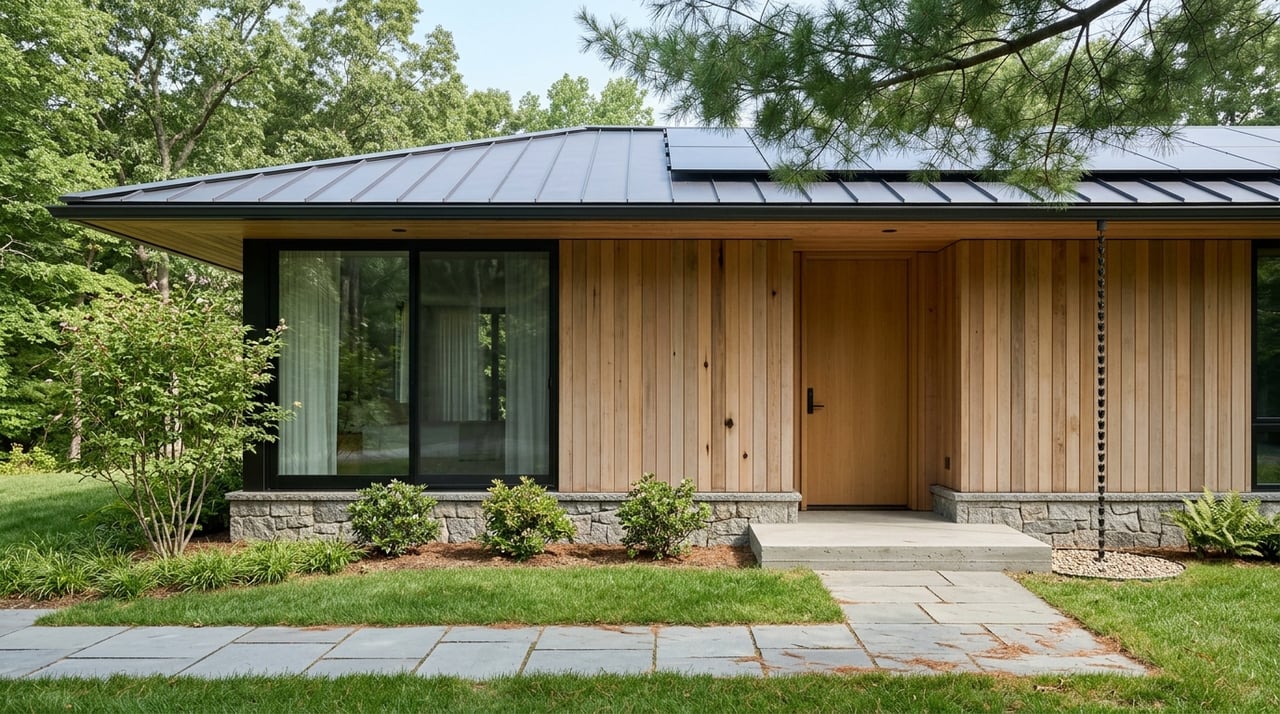
Contemporary eco-conscious homes in Lincoln often present as clean, simpler forms with stronger building envelopes and updated systems. You may also see landscaping choices that help manage water, preserve privacy, and reduce site impact.
A visible local example is Oriole Landing, which the town describes as LEED-certified and built with low-impact development techniques such as rain gardens. It also includes bicycle storage, a community vegetable garden, and a preserved historic house that was repurposed as a garden house.
While Oriole Landing is not a single-family example, it still shows the broader direction Lincoln supports today. Efficiency, site sensitivity, and adaptive reuse are not fringe ideas here. They are part of the town’s architectural conversation.
Historic Districts Matter in Lincoln
When you evaluate a home in Lincoln, architectural style is only part of the picture. Local review can also affect what changes may be possible over time.
Lincoln currently has three local historic districts, and the Historic District Commission reviews permanent exterior alterations visible from a public way, new construction, and demolitions within those districts. If a home sits in one of these areas, planning for renovations should happen early.
That does not mean change is impossible. It does mean design decisions, timelines, and approval processes may matter just as much as your wish list.
How to Read Lincoln Listings
If you are browsing listings in Lincoln, certain terms can help you quickly identify the architectural story behind a home.
Signs of Farmhouse or Estate Tradition
Look for references such as:
- Barns
- Carriage houses
- Acreage
- Gardens
- Estate names
- Fields or woodlands
These details often point to Lincoln’s older farmhouse and country-estate lineage.
Signs of Mid-Century Modern
Watch for phrases like:
- Glass walls or extensive glazing
- Low horizontal lines
- Wooded privacy
- Flat roof
- Architect attribution
- Mid-century neighborhood location
These details often suggest a home connected to Lincoln’s modernist legacy.
Signs of Eco-Conscious Design
Newer or updated homes may mention:
- Solar readiness
- Heat pumps
- LEED certification
- Rain gardens
- Low-impact development
- High-efficiency systems
These features often signal a more contemporary, performance-focused approach.
Why Lincoln’s Mix Stands Out
What makes Lincoln so compelling is not simply that it has both old and new homes. It is that the town has created space for historic preservation, Modern design, and climate-conscious building to coexist within a landscape-first setting.
That balance gives Lincoln unusual architectural range. You can see it in a historic farmhouse shaped by generations of agricultural use, a Modern house tucked into the woods, or a newer home designed around efficiency and site sensitivity.
If you are buying, this range gives you real choice, but it also makes local interpretation more important. If you are selling, understanding where your home fits within Lincoln’s broader architectural story can help shape pricing, positioning, and how the property is presented to the market.
Whether you are drawn to a legacy estate, a mid-century icon, or a more contemporary retreat, Lincoln rewards buyers who look beyond square footage and pay attention to design, setting, and long-term fit. If you want thoughtful guidance on evaluating distinctive homes in Greater Boston’s western suburbs, Teri Adler offers a calm, informed approach tailored to your goals.
FAQs
What architectural styles are most common in Lincoln, MA?
- Lincoln is especially known for historic farmhouses and country estates, mid-century Modern homes, and contemporary eco-conscious design shaped by the town’s conservation focus.
Why is mid-century Modern architecture important in Lincoln?
- The Lincoln Historic District Commission says more than 300 Modern residences were built between the 1930s and 1970s, and Modern architecture is considered central to the town’s appearance today.
How does conservation affect home design in Lincoln?
- Lincoln’s large amount of conservation land and trail space helps shape homes that are often set back from the road, surrounded by trees, and designed to blend into the landscape.
What should buyers know about historic districts in Lincoln?
- Lincoln has three local historic districts, and exterior changes visible from a public way, new construction, and demolitions within those districts may be reviewed by the Historic District Commission.
How can you spot a Modern home in a Lincoln listing?
- A Lincoln Modern home may be described with features such as flat roofs, rectilinear forms, extensive glass, low horizontal massing, wooded privacy, or ties to architect-designed or mid-century neighborhoods.